25 Salary, allowances etc.
IITB faculty salary, IIT Bombay pay scale, HRA, dearness allowance, academic grade pay
Your salary is paid directly to your bank account on the last day of the month. The Financial Year for tax purposes is from April 1\(^{\text{st}}\) of a given year to March 31\(^{\text{st}}\) of the following year. The income tax uses assessment year for submission of Income Tax Returns, which is the financial year in which the return is filed1. The salary slip is made available to every employee around the end of the month in their SAP login, and it provides details of earnings, deductions and the net pay that will be credited to the bank account of the employee. The salary slip of every employee is uploaded on the internal website of the Institute http://ep.iitb.ac.in.
25.1 Components of salary
The salary that you get has several components.
Pay at Pay Level: We outline the pay scales with reference to the 7\(^{\text{th}}\) Pay Commission, that is currently in force, below. The position to which you are appointed (or move to after selection to a higher post) defines the salary. All Government servants in India are placed in one of these pay levels. Faculty members in Institutes such as IITs are placed in one of the following pay levels. D.A. stands for “Dearness Allowance”, described subsequently.
- Pay Level 10: Salary range ₹ 57,700 to ₹ 98,200 (plus D.A.) per month.
- Pay Level 11: Salary range ₹ 68,900 to ₹ 117,200 (plus D.A.) per month.
- Pay Level 12: Salary range ₹ 101,500 to ₹ 167,400 (plus D.A.) per month.
- Pay Level 13A1: Salary range ₹ 131,400 to ₹ 204,700 (plus D.A.) per month.
- Pay Level 13A2: Salary range ₹ 139,600 to ₹ 211,300 (plus D.A.) per month.
- Pay Level 14A: Salary range ₹ 159,100 to ₹ 220,200 (plus D.A.) per month.
- Pay Level 15: Salary range ₹ 182,200 to ₹ 224,100 (plus D.A.) per month.
Your salary within the pay band is fixed at the time of your appointment and increases every year by an increment, as defined in the 7\(^{\text{th}}\) Pay Commission Pay Matrix. The various cadres, processes for selections, and salary scales (that is, Pay Levels as listed above) for the faculty are as follows. Note that they are automatically moved to the higher levels as they gain experience through their career.
Assistant Professor: Assistant Professors fall into the following levels, based on their experience:
- 0 to 3 years of post-PhD experience (Assistant Professor Grade II): Pay Level 10 or 11, with increments based on experience, plus D.A.
- 3 years or more of post-PhD experience (Assistant Professor Grade I): Pay Level 12, with a starting salary of ₹ 101,500, with increments based on experience, plus D.A. per month.
- After 3 years in Pay Level 12 (Assistant Professor Grade I): Pay Level 13A1 with a starting salary of ₹ 131,400, with increments based on experience, plus D.A. per month.
If you have joined IIT after having served for some time as Assistant Professor in another IIT or a central University or NIT, your previous experience will be counted for movement to Assistant Professor (Grade I).
As mentioned earlier, selected candidates with less than the requisite experience as specified in the advertisement may be taken as Assistant Professor (Grade II) in Pay Level 10 or 11. While, technically, appointment to this position does not automatically imply ultimate absorption in the IIT, we have adopted a system of internal assessment as explained in the section on regularization.
Associate Professor: Pay Level 13A2, with increments based on experience, plus D.A.
Professor: Pay Level 14A, with increments based on experience, plus D.A.
The Institute website (see ‘Recruitment’ link) carries the minimum eligibility criteria for all the above positions.
In addition, the following scales are applicable as appropriate to faculty:
Professor (HAG Scale): From 18\(^{\text{th}}\) August 2009, a senior cadre of Professors has been created. The scale pay for this cadre is known as HAG (Higher Administrative Grade). The minimum eligibility criteria for this scale is six years of service as a Professor. A maximum of 40% of the total number of Professors can be placed in this scale. The corresponding Pay Level is 15, and the salary range is from ₹ 182,200 to ₹ 224,100 per month. Currently, it takes about 12 years to become a HAG scale Professor after becoming Professor. Those Professors of CFTIs who are appointed as Director in CFTIs by the MoE, shall be deemed to have been placed in the HAG scale notionally from the day they took charge as Director in CFTIs or from the day guidelines were issued by MHRD vide its letter No. F.23-1/2008-TS.II dated 18.08.2009, whichever is later.
Institute and Endowed Chairs for faculty: As a means of recognizing outstanding performance, the Institute has several Chair Professor positions. While most of these are at the Professor’s level, there are a few at other levels also. Funding for several of these comes from endowments, and is managed by the Dean (ACR)’s office, which also takes an active role in raising funds for further Chairs. The selection to these Chairs is done by a Selection Committees. The tenure of the Chair Professorship position is for a period of three years, and the chair is re-advertised at the end of that period. With effect from 21.06.2024, faculty who hold Chairs receive the following in addition to their salaries:
Chair Professor (full Professors): ₹9 lakhs per year, made up of a monthly honorarium of ₹50,000 and an annual research grant of ₹3 lakhs; 3 years; at most 20% of Professors at a time.
Chair Faculty (Associate and Assistant Professors): ₹6.6 lakhs per year, made up of a monthly honorarium of ₹30,000 and an annual research grant of ₹3 lakhs; 3 years; at most 5% of Associate Professors and 5% of Assistant Professors at a time.
Distinguished Chair (new; highly accomplished faculty members and emeritus fellows): ₹1 lakh per month and a research grant of ₹5 lakhs per year; 3 years; limited to four or five faculty members at any time.
Other existing terms of Chair Professorship continue. (Source: Circular No. Reg/F&SS/2024 dated 15.01.2025.)
Dearness Allowance: A component termed as Dearness Allowance to take care of rising prices due to inflation is also a part of your pay package. The rate of Dearness Allowance is revised by the Government every January and July based on consumer price indices.
House Rent Allowance (HRA): If you do not stay in Institute-provided accommodation, you will also receive House Rent Allowance (HRA) which is 30% of your basic pay. The allowance is payable even when you stay in an accommodation owned by you. (Interestingly, if both spouses are employees of the Institute, both can claim HRA if the accommodation is rented or is owned. However, if either of them has a Government accommodation, HRA cannot be claimed by either). HRA is taxable. If, however, you live in a rented accommodation, the HRA that you receive may be fully or partially exempt from income tax. The amount of exemption that can be claimed is the least amount out of the following three: (i) the HRA received, (ii) rent that you actually paid over and above 10% of your basic pay and (iii) 50% of your basic salary.
Transport Allowance: All employees, irrespective of whether they live within the campus or commute from outside, are eligible to receive a transport allowance. For those in the faculty cadre, the rate of transport allowance is ₹ 7,200 per month. In addition, the Dearness Allowance at prevailing rate is payable on this amount as well. (Note: The transport allowance payable to the blind or orthopedically handicapped employees is double this rate).
25.2 Annual Increment
Every year employees are given an increment in their salary. The pay in the pay band increases to an amount that is the next cell in the Pay Matrix (corresponding to an approximately 3% increase in salary). The yearly increment is given from the first day of January or July of every year. However, the first increment can be availed only after completing six months in a given pay. This means that, if you are appointed between July and 1\(^{\text{st}}\) January, (of the following year), you are eligible for an increment in the following July but if the date of appointment is between 2nd January to June, you will get the first increment in January of the following year. If the employee is on leave, other than casual leave, on the first day of the increment, the increment is given from the day when the employee rejoins the duty.
| Level \(\rightarrow\) | 10 | 11 | 12 | 13A1 | 13A2 | 14 | 14A | 15 |
|---|---|---|---|---|---|---|---|---|
| Cell \(\downarrow\) | ||||||||
| 1 | 57700 | 68900 | 101500 | 131400 | 139600 | 144200 | 159100 | 182200 |
| 2 | 59400 | 71000 | 104500 | 135300 | 143800 | 148500 | 163900 | 187700 |
| 3 | 61200 | 73100 | 107600 | 139400 | 148100 | 153000 | 168800 | 193300 |
| 4 | 63000 | 75300 | 110800 | 143600 | 152500 | 157600 | 173900 | 199100 |
| 5 | 64900 | 77600 | 114100 | 147900 | 157100 | 162300 | 179100 | 205100 |
| 6 | 66800 | 79900 | 117500 | 152300 | 161800 | 167200 | 184500 | 211300 |
| 7 | 68800 | 82300 | 121000 | 156900 | 166700 | 172200 | 190000 | 217600 |
| 8 | 70900 | 84800 | 124600 | 161600 | 171700 | 177400 | 195700 | 224100 |
| 9 | 73000 | 87300 | 128300 | 166400 | 176900 | 182700 | 201600 | |
| 10 | 75200 | 89900 | 132100 | 171400 | 182200 | 188200 | 207600 | |
| 11 | 77500 | 92600 | 136100 | 176500 | 187700 | 193800 | 213800 | |
| 12 | 79800 | 95400 | 140200 | 181800 | 193300 | 199600 | 220200 | |
| 13 | 82200 | 98300 | 144400 | 187300 | 199100 | 205600 | ||
| 14 | 84700 | 101200 | 148700 | 192900 | 205100 | 211800 | ||
| 15 | 87200 | 104200 | 153200 | 198700 | 211300 | |||
| 16 | 89800 | 107300 | 157800 | 204700 | ||||
| 17 | 92500 | 110500 | 162500 | |||||
| 18 | 95300 | 113800 | 167400 | |||||
| 19 | 98200 | 117200 |
25.3 Deductions
When you receive your salary slip, you will find some deductions as well. The primary deductions are:
Income Tax: Income tax rates are as per finance bill passed by the Parliament every year. It is possible to minimize your tax liability through some tax saving mechanisms. Almost every academic unit has a local expert on such matters for advising you on this. Filing an income tax return every year is compulsory. Unless the last date is extended, returns have to be filed by 31\(^{\text{st}}\) July of the following financial year for which the return is being filed. From the assessment year 2013-14 e-filing of your income tax return has been made mandatory. You will need to complete a one-time registration process at the Income Tax e-Filing website. Your PAN number will be your user-id. You will also be required to link your Aadhaar to your PAN at this stage. You can view your tax credit (form 26AS) once you login (you will also be able to see it at your net banking website). The income tax return can be filled up directly on the e-Filing website. On successful submission of your return, the system will generate an acknowledgement (called ITR-V). You can either choose to e-verify your return submission using an Aadhaar based OTP. Otherwise, take a print out of this acknowledgement, sign it and send it to the address mentioned in this form by ordinary post or speed post and you are done. (Incidentally ITR-V is password protected with a long 18 digit password consisting of your pan number in lower case followed by your date of birth in ddmmyyyy format.) You can get all the necessary information from the Income Tax Department website http://incometaxindia.gov.in.
Please note that if you have income from sources other than from the Institute and the bank deposits, or if you are expecting a refund of income tax, you have to add these while filing your return.
Professional Tax: Currently ₹ 2,500 per year.
Contribution to CPF/GPF/NPS.
License Fee and utility charges for your quarter in the campus.
There will be deductions for Group Term Insurance and Scheme (GTIS) and Post Retirement Medical Scheme (PRMS).
25.4 Leave Travel Concession (LTC)
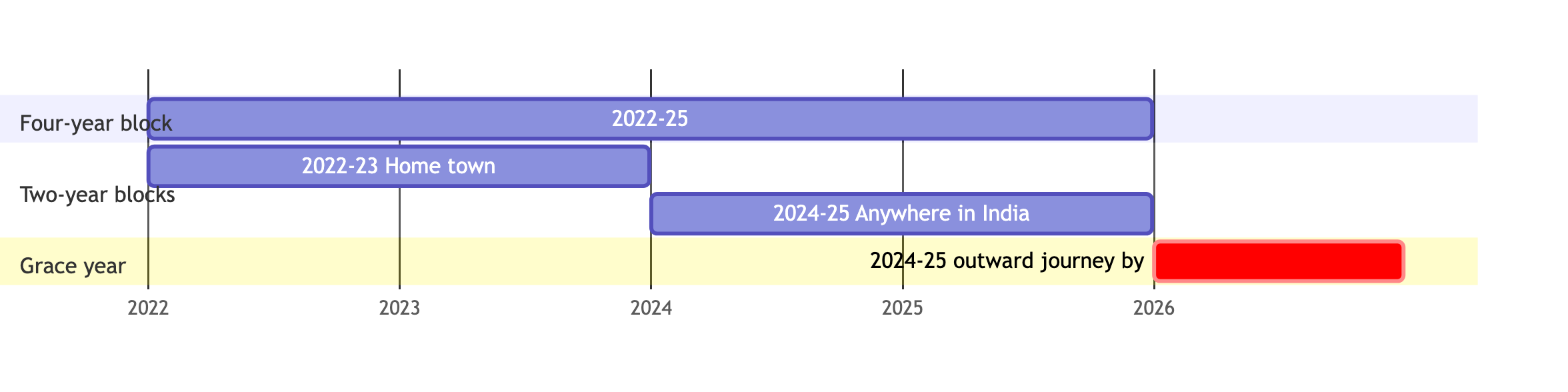
Once every two years, you are eligible for a paid travel to your home town. For the purpose of LTC, block years are defined for two years starting 1\(^{\text{st}}\) January of an even year (e.g. 2024) to 31\(^{\text{st}}\) December of an odd year. If you do not avail LTC during this block year it generally lapses. However, it has been the practice of the Government to allow for a grace year, that is, LTC for the block year 2024-25 can be availed (that is, outward journey commenced) up to 31\(^{\text{st}}\) December 2026.
Two of the above blocks are combined together to define a four year block, e.g. the block years 2022-23 and 2024-25 are combined to define a four year block of 2022-25.
In this four year block, one can avail LTC for home town travel in one two-year block and another LTC to anywhere in India (including home town) in the other second two-year block. The four year block also has a grace period of one year, that is, the 2024-25 block must be utilized (that is outward journey commenced) before 31/12/2026.
25.4.1 Eligibility:
The employee appointed on scale must have completed one year of service in the block to be eligible for LTC in the block, that is, those who are appointed up to 31-12-2024. are eligible for LTC in the block year 2025 but those appointed after this day are not eligible.
All the declared dependents are eligible for LTC and the travel need not be taken up together. All return journeys must be completed within six months of outward journey.
If both the spouses are working for the Institute, they can claim LTC separately only if the declared dependents are different. The children can avail LTC only from one of the parents. If you take LTC for spouse under your LTC entitlement, he/she cannot independently claim LTC for self. Each spouse can declare separate “Home Town” and take LTC for their respective hometowns.
25.4.2 Special provision for New Appointees:
Fresh appointees are eligible for LTC once every year for two blocks of four years each. This means that, during the first eight years of service, an employee can avail one LTC every year. The definition of the block years remain the same. (Illustration: Suppose an employee joined in 2019. He/she can travel on LTC to his/her hometown in 2020, 2021 and 2022 and one anywhere in India LTC in 2023. In the next block, that is 2024-2027 he/she can avail three home towns and one anywhere in India, till he/she completes eight years of service.) After the first 8 years of service, the regular LTC rules described earlier apply.
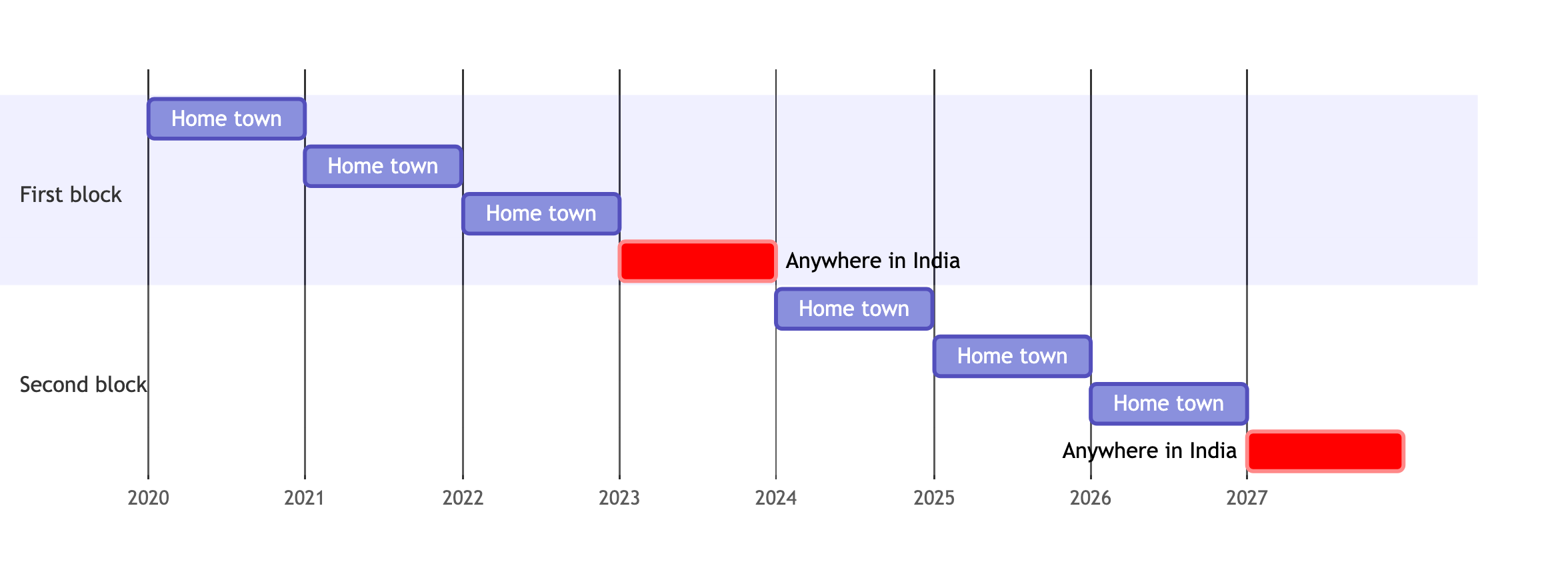
The all India LTC can be availed only on the 4th occasion of the block and not at random.
25.4.3 Encashment of Leave for LTC:
Normally, Government employees cannot encash their accumulated earned leave excepting at the time of retirement. However, at the time of taking LTC an employee is permitted to encash up to 10 days of accumulated earned leave with prior approval, subject to the condition that such encashment will not exceed 60 days during the entire career of an employee for which a balance of at least 30 days of earned leave is must. The request for each encashment should be made prior to availing the LTC. If both husband and wife are employees, each can encash such earned leave even when they are traveling together. The encashment of earned leave for the purpose of LTC will not have any bearing on the maximum number of days (300) for which earned leave can be cashed at the time of retirement.
25.4.4 Travel Eligibility:
Faculty and all dependents are eligible to travel by air2. Employees in Pay Level 9 to 13 are eligible for Economy Class, while those in Pay Level 14 and above (Professors) are eligible for Business Class. Similarly, employees in Pay Levels up to 11 are eligible for Second Class AC train fare, while those in Pay Levels 12 and above are eligible for First Class AC train fare. These are the same classes as for official tours (see Domestic travel). Please note that no taxi or road mileage is admissible to reach the airport/railway station or for internal travel to destination except where road travel is done by buses run by Government organizations (for which you will have to produce the tickets). LTC rules are strictly observed, and it is necessary to attach photocopies of your tickets along with your claim (in case of air travel, boarding passes must be retained and produced along with e-tickets; production of an e-ticket without the boarding passes is not acceptable as proof of travel.) For journeys which involve water transport, detailed rules are available with the administration.
Booking air tickets for LTC
- Air tickets for LTC must be booked through one of the Authorized Travel Agencies: Balmer Lawrie & Co. Ltd., Ashok Travels & Tours or IRCTC.
- Tickets must be booked under the category “LTC”, not “Corporate”; otherwise the claim cannot be allowed. The ticket must show the word “LTC”.
- Booking on the website of one of these three agents is itself proof that the cheapest fare was booked; no screenshot is needed. (Employees not entitled to air travel who fly under the Special Dispensation Scheme to NER/J&K/A&N/Ladakh must still keep a printout of the flight and fare details for the relevant railhead.)
- For official travel (TA) by air, no screenshot is required. Employees should choose the “Best Available Fare” in their entitled class, the cheapest fare available, preferably non-stop, in the desired 3-hour time slot on the day of travel, with a 10% price band allowed for convenience.
Sources: Circular No. C&A/LTC/2026 dated 22.04.2026; Circular No. C&A/TA/2026 dated 30.06.2026; DoPT OM F.No.31011/07/2025-PP.A-IV dated 01.07.2025, FAQs on CCS (LTC) Rules, circulated to faculty on 05.01.2026.
25.4.5 LTC Advance:
90% of the estimated cost of journey can be taken as an advance, only where the journey is expected to be completed by all persons travelling (including the return journey) within 90 days of taking the advance. In case the expected date of completion is more than 90 days, please draw advance only for outward journey.
When LTC advance is drawn and the tickets purchased for an amount lower than the advance drawn, the excess amount should be refunded to the Institute immediately. If this is not done penal interest on the excess amount is charged, which cannot be waived by authorities.
The employee must take formal leave for availing LTC for self. You cannot avail LTC using only the officially closed days. Faculty members can avail LTC during vacation also, but with prior intimation (with the destination specified) to administration. Submit the final LTC claim as soon as the return journey is completed.
Final LTC claim settlement: Submit the claim within the time limits. If an advance is not settled in time, it will be recovered suo-moto with penal interest @ 2% over GPF interest from the date of drawal to the date of recovery, as per rules.
Tickets for LTC travel are required to be booked through authorised agents viz. M/s Balmer Lawrie & Company, M/s Ashok Travels, or IRCTC.
25.5 Time limits for claims
| Claim | If an advance was drawn | If no advance was drawn |
|---|---|---|
| LTC | Within 30 days of the return journey | Within 60 days of the return journey |
| TA on official tours (India or abroad) | Within 15 days of the return journey | Within 60 days of the return journey |
| TA on retirement | Not applicable | Within 180 days of the journey |
| Medical | Within 30 days of discharge from hospital | Within 180 days of the end of treatment or discharge |
A late claim is forfeited. For LTC and TA, the whole advance is also recovered with penal interest. An unused medical advance must be refunded or is recovered.
Apply for TA/DA advances, settlements and reimbursements online on the EP portal, except for CPDA, Gymkhana, OTC, IoE and PTD funds. Offices aim to process advances, claims and other files within 3 working days for clear cases, 5 where more information is needed, and 7 for complicated cases.
(Sources: Office Order No. HR-2 (HCM 2)/TA/2021 dated 22.11.2021; Notification No. HR-2/HCM-2/TA/2024 dated 18.09.2024.)
Submit proof of payment with every claim. Bills and receipts must be in the claimant’s name. For UPI, NEFT/RTGS or card payments, include the transaction details. For cash payments, get a receipt from the payee. For bills of ₹ 10,000 and above, show that the supplier was paid.
Do not draw a fresh advance while an earlier advance of the same nature is outstanding, unless it is justified and approved.
25.6 Telephone Expense Reimbursement
A faculty member is entitled to reimbursement of telephone (landline at home and/or mobile connection) expenses up to ₹ 18,000 (₹ 21,600 for a Professor) per financial year. The amount includes ₹ 4800 towards internet connection at home. Since internet connections for all campus residents are provided by the Institute, the amounts accordingly reduce to ₹ 13,200 (₹ 16,800 for a Professor) for campus residents. For those not staying on campus (including those staying in Institute-leased accommodation off campus) the full amount is available for reimbursement provided they have supporting evidence for internet connection at home.
To claim this, telephone bills (including mobile bills and bills for internet charges) should be submitted to the accounts section. The faculty may choose to submit bills monthly, semi-annually or annually. As it is a reimbursement, no tax liability is due on this amount.
25.7 Newspaper Reimbursement
Employees at Pay Level 9 and above can claim reimbursement for newspapers bought or delivered at their residence, under the circular dated 02.01.2019. Claims are made every six months, online at my.iitb.ac.in/b/claims. The Administration announces the deadline for each period; for January to June 2026 it was 31.07.2026, and claims after the deadline are not accepted. A user guide (PDF) and a video explain the claim form.
25.8 Children’s Education Allowance
Expenses incurred in admitting upto two children through school (from Jr. KG to twelfth class) can be reimbursed. As per 7th CPC, the procedure for claiming the reimbursement of CEA/Hostel subsidy is changed to once in a year after completion of the financial year/end of Academic year. The CEA amount is fixed to ₹ 2,812.5/- per month per child irrespective of the actual expenses incurred by the Government Servant and Hostel subsidy ceiling amount is ₹ 8,437.5/- per month. The reimbursement will be done against the submission of a bonafide certificate issued by the Head of the Institution OR self attested copy of the report card OR self attested fee receipts confirming that the fee has been deposited for the entire academic year or for the period /year for which claim has been preferred. The Hostel Subsidy and Children Education Allowance can be claimed concurrently.
In order to claim reimbursement of hostel subsidy for an academic year, a certificate is to be produced from the Head of the Institution confirming that the child studied in the school along with amount of expenditure incurred by the Government servant towards lodging and boarding in the residential complex.
As an example, at the time of writing (January 2024), the financial year is 2023-24, while the assessment year for this period would be 2024-25.↩︎
Tickets should be booked only through M/S Balmer Lawrie & Co. Ltd., M/S Ashok Travels and Tours, or M/S Indian Railways Catering and Tourism Corporation Ltd.↩︎